A toothache that wakes you up at 3 a.m. or a cracked tooth during dinner can leave you wondering if you need to rush to get help right away.
Not every dental problem requires immediate care, but knowing the difference can help you make the right choice and potentially save your tooth.
A dental emergency is any problem with your teeth or gums that involves severe pain, uncontrolled bleeding, a cracked tooth, broken facial bones, or signs of serious infection.
These situations need quick action to prevent further damage or permanent tooth loss. Other dental issues can wait until your dentist’s regular office hours.
Understanding what counts as a true emergency helps you respond quickly when it matters most.
This guide will walk you through the types of dental emergencies, what to do in those first critical moments, and when you can safely wait for your regular dental appointment.
Key Takeaways
- True dental emergencies include severe bleeding, intense pain, knocked-out teeth, and serious infections that need immediate treatment
- Your first step should be to call your dentist’s emergency line, or visit an urgent care center if your dentist is unavailable
- Many dental injuries can be prevented by wearing protective gear during sports and maintaining good oral hygiene habits
Learn what is a dental emergency and how to respond quickly to protect your teeth and oral health.
Table of Content
- What Qualifies As a Dental Emergency?
- Types of Dental Emergencies That Need Immediate Attention
- Other Time-Sensitive Dental Problems
- First Steps: What to Do in a Dental Emergency
- Prevention and Reducing Risk of Dental Emergencies
- Frequently Asked Questions
What Qualifies As a Dental Emergency?
A dental emergency involves any issue that causes severe pain, uncontrolled bleeding, or could result in tooth loss without quick treatment.
Knowing the signs of urgent problems helps you decide when to contact your dentist right away versus when you can wait for a regular appointment.
How to Recognize Urgent Dental Issues
Urgent dental issues need attention within hours, not days. A knocked-out tooth is one of the most time-sensitive problems you can face.
Your dentist has the best chance of saving it when it’s put back in place within one hour.
Other urgent signs include a tooth that’s been partially pushed out of position or one that’s badly cracked. If you notice swelling in your face or jaw, this often points to an infection that needs immediate care.
Bleeding that won’t stop after 15 to 20 minutes of applying pressure also qualifies as urgent. The same goes for injuries to your tongue, cheeks, or lips that cause heavy bleeding.
When you’re searching for emergency dental care, these are the situations that can’t wait.
Key Symptoms That Mean Immediate Care
Severe pain is your body’s way of telling you something is seriously wrong. If over-the-counter pain relievers don’t help or the pain gets worse, you need to see an emergency dentist.
Watch for these warning signs:
- Intense toothache that doesn’t respond to medication
- Pus or discharge around a tooth or gum area
- Fever along with dental pain
- Difficulty swallowing or breathing
- Numbness in your mouth or face
- Swelling that spreads to your eye or neck
A dental abscess creates a pimple-like bump on your gums and can spread infection to other parts of your body if left untreated. Any swelling of your face, jaw, or neck means you should seek immediate care.
Broken facial bones require a trip to the emergency room rather than just calling your dentist.
Differences Between Emergency and Non-Emergency Dental Problems
Not every dental problem requires urgent dental care. Understanding the difference helps you make smart choices about when to seek help.
Emergency problems include knocked-out teeth, severe infections, uncontrolled bleeding, and intense pain. Non-emergency issues can wait for a regular appointment during business hours.
| Emergency | Non-Emergency |
| Severe, constant pain | Dull or mild toothache |
| Knocked-out tooth | Small chip without pain |
| Badly cracked tooth | Broken braces wire |
| Facial swelling | Food stuck between teeth |
| Heavy bleeding | Minor cut or sore |
| Loose adult tooth | Lost filling without pain |
A small chip that doesn’t hurt or sharp edges that you can cover with orthodontic wax doesn’t count as what is considered a dental emergency. The same applies to a lost filling if you’re not in pain.
If you’re unsure whether your situation needs immediate attention, call your dentist’s office for guidance. Many dentists have emergency numbers you can reach after hours.
Schedule your visit in Lackawanna NY for urgent care if you are facing a dental emergency.
Types of Dental Emergencies That Need Immediate Attention
Dental emergencies range from severe toothache and dental pain to knocked-out teeth and infections that cause facial swelling.
Understanding which problems need urgent care helps you act quickly to protect your teeth and overall health.
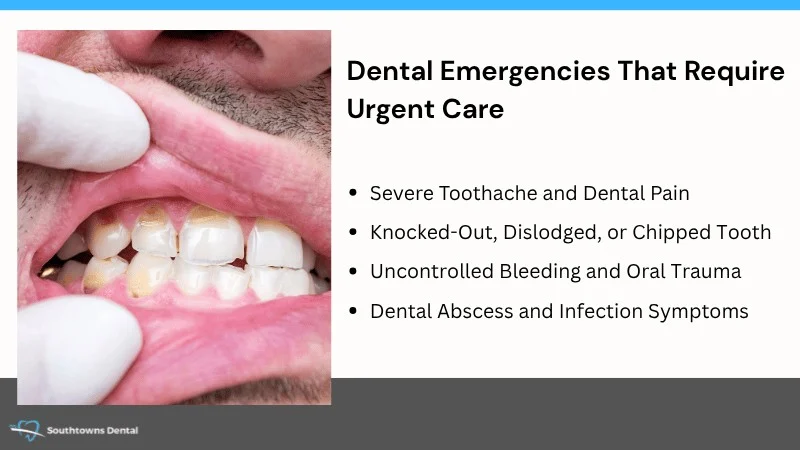
Severe Toothache and Dental Pain
A severe toothache that doesn’t respond to over-the-counter pain medication requires immediate attention.
This type of dental pain often signals a serious problem like tooth decay that has reached the nerve or an infection spreading inside your tooth.
You should seek emergency care if your tooth pain is intense and constant. Pain that wakes you up at night or prevents you from eating also qualifies as urgent.
Severe tooth pain that doesn’t improve with medication may indicate you need emergency care at a hospital.
Sharp pain when you bite down or sensitivity to hot and cold that lasts more than a few seconds can point to a cracked tooth.
Jaw pain that comes with tooth pain might signal a dental abscess spreading to surrounding tissues. Don’t wait to see if the pain goes away on its own because delayed treatment can lead to more serious complications.
Knocked-Out, Dislodged, or Chipped Tooth
A knocked-out tooth is one of the most time-sensitive dental emergencies you can face. You have about 30 minutes to an hour to save the tooth if you act fast.
Pick up the tooth by the crown, not the root, and rinse it gently with water if it’s dirty.
Try to place the tooth back in its socket if possible. If you can’t do that, keep it moist by putting it in milk or holding it between your cheek and gums.
Knocked-out teeth demand immediate care to have the best chance of saving them.
A dislodged tooth that has been pushed out of position also needs urgent attention. Try to gently move it back to its normal position using light finger pressure, but don’t force it.
Even a chipped tooth can become an emergency if the break is large or causes sharp edges that cut your mouth. A cracked tooth that causes pain requires immediate care because the crack can expose the inner tooth to bacteria.
Uncontrolled Bleeding and Oral Trauma
Uncontrolled bleeding from your mouth is a clear sign you need emergency dental care. Dental emergencies include severe bleeding that requires immediate attention to stop the blood flow and prevent complications.
Apply firm pressure with clean gauze or a cloth to the bleeding area for 10 to 15 minutes.
If the oral bleeding continues after 15 minutes of pressure, you need to see a dentist right away.
Uncontrollable bleeding can happen after tooth extraction, from injuries to your gums or tongue, or from dental trauma involving broken facial bones.
Dental trauma from accidents, falls, or sports injuries may cause both bleeding and damage to your teeth and jaw.
A jaw fracture requires immediate medical attention and often involves symptoms like difficulty opening your mouth, misaligned teeth, or severe jaw pain.
Bleeding that won’t stop or broken facial bones requires dental emergency care. Don’t wait to seek help if you experience significant trauma to your mouth or face.
Dental Abscess and Infection Symptoms
A dental abscess is a pocket of pus caused by a bacterial infection that can become life-threatening if left untreated.
Dental infections require prompt treatment to prevent the infection from spreading to other parts of your body.
Warning signs of a dental infection include facial swelling, a bump on your gums that looks like a pimple, fever, and a bad taste in your mouth. You might also notice swollen lymph nodes under your jaw or in your neck.
Facial swelling that makes it hard to breathe or swallow is extremely serious. The infection can spread to deep spaces in your neck and cause airway problems.
Don’t try to drain the abscess yourself or ignore the symptoms. Even if the abscess ruptures and the pain decreases, you still need treatment because the infection remains active inside your tooth and surrounding tissue.
Contact our team in Lackawanna NY to get help fast when dealing with a dental emergency.

Other Time-Sensitive Dental Problems
Some dental issues don’t threaten your life but still need quick attention to prevent pain and avoid costly repairs. A lost filling or crown, broken braces, or loose teeth can worsen rapidly if you don’t act fast.
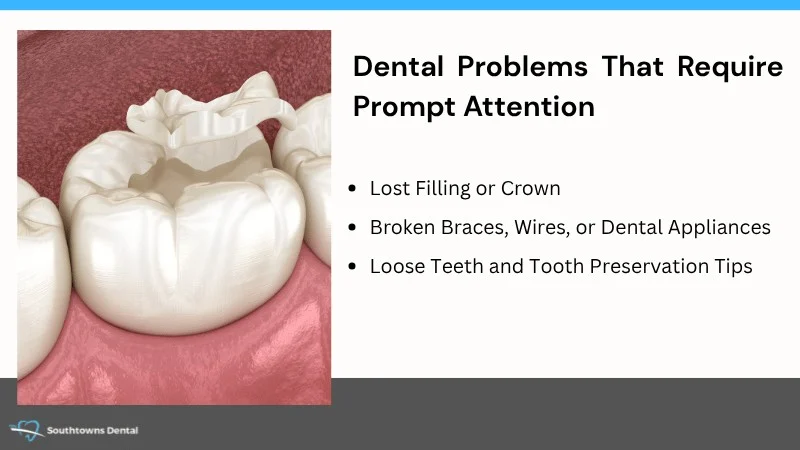
Lost Filling or Crown
When you lose a filling or crown, your tooth becomes vulnerable to damage and infection. The exposed tooth often feels sensitive to hot, cold, and pressure.
You should call your dentist within 24 hours to schedule a repair. In the meantime, you can buy temporary dental cement at most pharmacies to protect the exposed area.
Clean the crown gently and try to slip it back over your tooth with the dental cement if possible.
Don’t use super glue or other household adhesives on your teeth. These products can damage your tooth and gum tissue.
If you’ve lost a filling, you can place a small amount of sugarless gum in the cavity as a temporary barrier until you see your dentist.
Avoid chewing on the affected side of your mouth. Hard or sticky foods can cause further damage to the weakened tooth structure.
Broken Braces, Wires, or Dental Appliances
Broken braces or poking wires can cut your cheeks, tongue, and gums. A loose bracket might not seem urgent, but it can slow down your treatment progress.
Contact your orthodontist right away to determine if you need an emergency appointment. Some issues can wait until your next scheduled visit, while others need immediate fixes.
If a wire is poking you, try using the eraser end of a pencil to gently push it into a more comfortable position.
You can cover sharp edges with orthodontic wax to protect your mouth tissues. Most orthodontic offices provide this wax, but you can also buy it at drugstores.
Never cut the wire yourself, as you might swallow it or cause more damage.
Loose Teeth and Tooth Preservation Tips
Adult teeth should never feel loose. A loose tooth usually signals gum disease, injury, or bone loss that requires prompt dental care.
Try to keep the tooth in place by gently biting down. Don’t wiggle or touch it with your tongue, as this can make it looser. Contact your dentist the same day for an evaluation.
If the tooth falls out completely, handle it only by the crown and never touch the root. Rinse it gently with milk or saline solution if it’s dirty.
The best way to save your tooth is to place it back in the socket immediately if you can do so without forcing it.
If reinsertion isn’t possible, store the tooth in milk, your saliva, or a tooth preservation kit until you reach the dentist. You have about 30 minutes to an hour for the best chance of saving the tooth, so time matters greatly.
First Steps: What to Do in a Dental Emergency
Acting quickly during a dental emergency can mean the difference between saving and losing a tooth.
Knowing how to control bleeding, manage pain, and decide where to seek care helps you protect your oral health until professional treatment is available.
Immediate Self-Care Before Seeing the Dentist
The first thing you should do is call your dentist for instructions. Many dentists have emergency numbers you can call after hours.
For a severe toothache, rinse your mouth with warm water and use dental floss to remove any stuck food. Apply a cold compress to the outside of your mouth to reduce swelling.
Take over-the-counter pain relievers like ibuprofen or acetaminophen. Never place aspirin directly on your gums because it will burn the tissue.
If you have a knocked-out tooth, hold it by the crown and rinse it gently with water. Don’t scrub the tooth or remove any attached tissue.
Try to place the tooth back in its socket facing the right way, but don’t force it. If you can’t reinsert it, put the tooth in a small container of milk or water with a pinch of salt.
For bleeding from a cut or injury, rinse your mouth with warm salt water. Press a clean piece of gauze against the bleeding area for 15 to 20 minutes.
You can also use a moistened tea bag because tea contains tannic acid that helps stop bleeding.
When to Go to the Emergency Room
You should go to the emergency room if your dentist’s office is closed and you have severe pain or bleeding that won’t stop. The ER is also necessary if you have broken facial bones or swelling that affects your breathing.
Emergency room staff can give you antibiotics and pain medication to help manage your symptoms. They can also treat serious injuries to your face and jaw.
However, the ER doesn’t perform dental work like fillings or crowns.
You’ll still need to see your dentist as soon as their office opens. ER care is meant to stabilize your condition and prevent infection until you can get proper dental treatment.
Tips to Prevent Infection and Save Teeth
Time matters when trying to save a tooth. Your dentist has the best chance of saving a knocked-out tooth when it’s returned to its socket within one hour.
Keep the tooth moist at all times. Milk is the best option for storage because it helps preserve the tooth’s root cells. If you don’t have milk, use water with a small amount of salt or a product designed for tooth storage.
For a dental abscess or swelling, rinse your mouth several times a day with a mild salt-water solution. Mix half a teaspoon of table salt in 8 ounces of water. This helps draw out infection and reduces bacteria in your mouth.
Never use super glue on broken teeth or dental work. Use orthodontic wax to cover sharp edges that might cut your tongue or cheeks.
For a lost filling, you can temporarily fill the cavity with sugarless gum or over-the-counter dental cement until you see your dentist.
Prevention and Reducing Risk of Dental Emergencies
Many dental emergencies can be avoided with the right preventive steps and protective measures.
Understanding what causes these problems and taking action to protect your teeth makes a real difference in your oral health.
Common Causes of Dental Emergencies
Trauma from accidents and sports injuries ranks among the most frequent causes of dental emergencies. A fall, car accident, or contact during athletic activities can crack, break, or knock out your teeth.
Tooth decay creates another major risk. When cavities go untreated, they weaken your tooth structure and can lead to severe pain or infection. The decay may reach the tooth’s nerve, causing an abscess that requires immediate attention.
Infections in your gums or teeth can quickly become serious emergencies. A dental abscess won’t heal without professional treatment and can spread to other parts of your body.
Chewing hard objects also causes problems. Ice, hard candy, popcorn kernels, and even pens can crack your teeth. Your teeth aren’t tools, so using them to open packages or bottles puts them at risk of breaking.
How Regular Dental Checkups Help
Regular dental checkups are your best defense against dental emergencies. Your dentist can spot early signs of tooth decay, abscesses, or fractured teeth before they turn into bigger problems.
During routine visits, your dentist examines your teeth and gums for weak spots. They can treat small cavities before they grow large enough to cause severe pain.
X-rays reveal problems hiding beneath the surface that you can’t see or feel yet.
Professional cleanings remove plaque and tartar buildup that brushing and flossing miss. This prevents gum disease, which can lead to tooth loss and infections.
Your dentist also checks old fillings and crowns to make sure they’re still secure. Catching a loose filling early means a simple repair instead of an emergency visit later.
Protective Gear and Healthy Habits

Wearing a mouthguard during sports protects your teeth from impact injuries. Custom-fitted mouthguards from your dentist offer the best protection and comfort.
They’re especially important for contact sports like football, hockey, basketball, and soccer.
Your daily habits matter too. Brush twice daily with fluoride toothpaste and floss once a day to keep tooth decay and gum disease away. These simple steps strengthen your teeth and gums.
Avoid chewing on hard items like ice, popcorn kernels, or pen caps. Don’t use your teeth to open bottles or tear packages. Be careful eating hard foods like nuts or hard candy.
If you grind your teeth at night, ask your dentist about a night guard. Grinding wears down your enamel and can crack your teeth over time.
Frequently Asked Questions
Some dental problems need attention within the hour, while others can wait for a regular appointment. Knowing which symptoms signal a true emergency can help you get the right care at the right time.
What symptoms mean I should see an emergency dentist right away?
You should seek immediate dental care if you have bleeding that won’t stop after 15 to 20 minutes of applying pressure. Severe pain that doesn’t improve with over-the-counter medication also requires urgent attention.
Broken facial bones need emergency room care rather than just a dental visit. Swelling in your face or jaw that makes it hard to breathe or swallow is another sign you need help right away.
If you have a dental abscess with visible swelling or a pimple-like bump on your gums, you should see your dentist as soon as possible. These infections can spread to other parts of your body if left untreated.
When does a toothache become serious enough to count as urgent?
A dull or mild toothache that you can manage with pain relievers usually isn’t an emergency. You should rinse your mouth with warm water and floss to remove any food stuck between your teeth.
However, severe toothache pain qualifies as a dental emergency. If your pain doesn’t get better with medication or keeps you from sleeping or eating, you need to contact your dentist right away.
Never put aspirin or other painkillers directly against your gums or tooth because it can burn your tissue. Apply a cold compress to the outside of your cheek instead.
Is a broken, chipped, or knocked-out tooth considered an emergency?
A knocked-out tooth is a serious emergency that requires immediate action. You should pick up the tooth by the crown, rinse it gently with water, and try to put it back in its socket if possible.
If you can’t reinsert the tooth, place it in a small container of milk or water with a pinch of salt. Your dentist has the best chance of saving a knocked-out tooth when it’s returned to its socket within one hour.
A badly cracked tooth also counts as an emergency, especially if you’re experiencing pain or bleeding. Save any broken pieces, rinse your mouth with warm water, and apply gauze if needed.
Small chips or cracks that don’t cause pain can usually wait for a regular appointment. You can cover any sharp edges with orthodontic wax to protect your tongue and cheeks until you see your dentist.
What should I do if I have swelling, bleeding, or signs of infection in my mouth?
For bleeding from injuries to your gums, tongue, or cheeks, rinse your mouth with salt water and apply pressure with gauze for 15 to 20 minutes. If the bleeding continues after that time, you need to see a dentist or go to the emergency room.
Swelling around a tooth or in your jaw often signals an infection that needs prompt treatment. You can rinse with a mild salt-water solution several times a day to help draw pus toward the surface.
A partially dislodged tooth that feels loose or out of position requires same-day dental care. Take over-the-counter pain medication and apply a cold compress while you wait to see your dentist.
What kinds of dental problems usually require restorative treatment rather than emergency care?
Lost or broken fillings and crowns need attention but usually aren’t emergencies. You can temporarily fill the cavity with sugarless gum or use over-the-counter dental cement until your appointment.
If you have a broken crown or bridge, you can try to put it back in place using dental cement or toothpaste. Don’t use super glue on dental restorations.
Broken braces and wires typically don’t require emergency care unless they’re causing bleeding. You can bend a poking wire with a pencil eraser and cover it with orthodontic wax.
Objects stuck between your teeth should be removed gently with dental floss or an interproximal brush. Never use sharp instruments to try to dislodge food or other items.
What can I expect to happen after a tooth extraction, and when should I be concerned?
Some bleeding, swelling, and discomfort are normal after a tooth extraction. You should bite down on gauze for 30 to 45 minutes after the procedure to help form a blood clot.
Minor oozing can continue for up to 24 hours, but heavy bleeding that soaks through gauze quickly isn’t normal. Contact your dentist if bleeding doesn’t slow down or if you develop severe pain after the first few days.
Swelling typically peaks around 48 to 72 hours after extraction and then gradually improves. If swelling gets worse after three days or you develop a fever, you may have an infection that needs treatment.
You should also call your dentist if you notice a bad taste or smell coming from the extraction site. These can be signs of dry socket, a condition where the blood clot comes out too early.