If you’re missing several teeth, you may be wondering whether you need a full denture or a partial.
The choice between full dentures vs partial dentures depends on how many healthy natural teeth remain, their condition, and the support available in your mouth.
Full and partial dentures both replace missing teeth, but they work differently. Full dentures replace all teeth in an upper or lower arch, while partial dentures fill gaps around suitable remaining teeth.
Before deciding, your dentist will evaluate which teeth can be preserved, how your gums and jawbone can support a denture, and which option best fits your everyday needs.
Understanding these differences can help you make an informed decision without rushing into unnecessary extractions.
What Is the Difference Between Full Dentures and Partials?
Your full denture replaces an entire arch, while your partial fills gaps around remaining natural teeth. Both types of removable dentures need a design that suits your mouth.
| What you’re comparing | Full dentures | Partial dentures |
| Teeth replaced | Entire upper or lower arch | Selected missing teeth |
| Natural teeth in that arch | None remain | Suitable teeth remain |
| Main support | Gums and underlying ridge | Teeth, gums, and ridge |
| Retention | Close fit and border seal | Clasps or attachments |
| Daily care | Clean appliance and mouth | Also brush and floss teeth |
Full Dentures Replace All Teeth in an Arch
You receive full dentures, also called complete dentures, for an arch with no natural teeth remaining. Your upper and lower arches are assessed separately. You might need a full denture on top and a partial below.
Your replacement teeth sit in a gum-colored base. The base rests against the tissues covering your jawbone and helps restore lost lip support.
Partial Dentures Fill Gaps Around Remaining Teeth
With partial dentures, you keep suitable natural teeth while replacing the missing ones. Your partial might fill one gap or several spaces across an arch. Its shape follows the location of those spaces.
Your remaining teeth also influence the design. A partial needs support that spreads chewing pressure without overloading a weak tooth.
How Their Support and Attachments Compare
Conventional full dentures rely on support from the gums and underlying jaw ridge, while implant-supported dentures use dental implants for additional retention or support.
Your partial uses clasps or other attachments to help hold it in place. Depending on its design, it shares pressure between your teeth and gums. A clasp alone does not make every partial secure or comfortable.
Which Teeth Can Be Kept, and Why Does That Matter?
Preserving natural teeth with a favorable long-term outlook may be beneficial when they can support a practical and healthy treatment plan.
At Southtowns Dental, our team evaluates the condition of your remaining teeth before recommending a full or partial denture.
This helps determine which teeth may be preserved and which replacement options are appropriate.
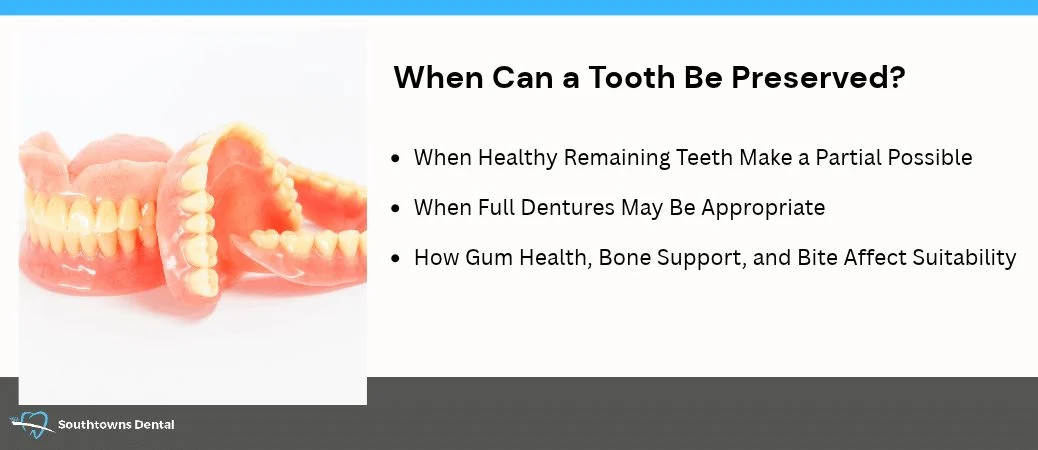
When Healthy Remaining Teeth Make a Partial Possible
Your remaining teeth need enough strength and support to work with a partial. Their location also counts: teeth spread across your arch offer different design choices from teeth grouped in one area.
Your dentist checks for decay, cracks, and movement.
A damaged tooth still deserves an assessment. Comparing root canal treatment vs. tooth extraction helps you weigh whether a tooth is repairable and worth keeping as part of your plan.
When Full Dentures May Be Appropriate
You have a clear reason to consider full dentures when an arch is already toothless. They are also an option when the remaining teeth have a poor outlook because of severe decay, fractures, or advanced gum disease.
Any recommendation for removal should include a tooth-by-tooth explanation.
Ask what keeping those teeth would involve and what risks remain after treatment. Before irreversible extractions, a second opinion is reasonable if you feel unsure about the plan.
How Gum Health, Bone Support, and Bite Affect Suitability
Your gum health and bone support help determine whether teeth are reliable anchors. Gum treatment addresses active disease before your dentist judges the final outlook.
X-rays and gum measurements help show support that you cannot assess by looking in a mirror.
Your bite also affects where chewing pressure lands. If a removable appliance does not suit your needs, discussing dental implants vs. a dental bridge adds other replacement choices to your treatment conversation.
How Do Comfort, Appearance, and Everyday Use Compare?
Your comfort and appearance rely on fit, bite, and denture design with either option. Keeping teeth changes how your appliance works, but neither choice guarantees an easier adjustment.
What to Expect When Eating and Speaking
You will need practice with a new appliance as your tongue and cheeks adjust. Start with soft foods in small pieces, and chew gently on both sides. Reading aloud helps you practice sounds that feel unfamiliar.
Your denture should receive attention if it repeatedly rocks or causes pain. Persistent denture sore spots call for a fit check; filing the base yourself risks making the problem worse.
How Materials and Fit Affect Appearance and Facial Support
Your tooth shade, tooth position, and gum-colored base work together to shape the result. With a partial, your replacement teeth should blend with the natural teeth beside them.
Ask whether any clasps will show when you smile.
Your denture base also replaces some lost tissue volume and supports your lips. During a try-in, check your face at rest as well as your smile.
If you consider implants, how dental implants look after healing also depends on the visible replacement teeth and surrounding gums.
When Adhesive Helps and When Implant Support Is Worth Discussing
You might use a small amount of denture adhesive to improve confidence with a well-fitting full denture.
Follow the product directions and remove the adhesive during cleaning. Increasing amounts or repeated slipping call for an examination.
Dental implants deserve discussion when movement limits your eating despite a well-made appliance.
With a removable implant-retained denture, you get greater stability through attachments to implants. Your health and available bone help determine whether you are a candidate for dental implants.
What Affects the Cost of Each Option?
Your total cost includes the appliance, any treatment needed beforehand, and future maintenance. Comparing written estimates with the same items included gives you a useful basis for deciding.
How Materials and Preparatory Treatment Shape the Price
Your partial denture price reflects its framework, replacement teeth, and attachment design. Your full denture price reflects materials and the work required to establish fit and bite.
Replacing fewer teeth does not guarantee a lower total bill.
You might also need extractions, gum treatment, fillings, or crowns before fitting.
Ask for those charges separately. Request a written estimate that outlines the denture, any preparatory treatment, follow-up adjustments, and potential maintenance costs.
Why Adjustments, Relines, and Repairs Matter to Long-Term Cost
Your gums and jaw ridge change over time, which affects how your denture fits. A reline reshapes the tissue-facing surface of the base. Repairs address damage such as a crack or a broken replacement tooth.
Ask which early adjustments are included and how later maintenance is billed. Your estimate should also explain whether an immediate denture will need relining or replacement after healing.
Avoid choosing solely by the appliance’s starting price.
What Happens During Fitting and Ongoing Care?
You move through examination, records, fitting, and follow-up before settling into daily denture care.
At Southtowns Dental Services, bring your questions about appearance and eating to the planning visit so your concerns stay part of the discussion.

From Examination and Impressions to Try-In and Fitting
Your first visit includes a review of your health, remaining teeth, gums, and bite. Your dentist then takes impressions or scans and records how your jaws meet. These records guide your denture design.
When your treatment allows a try-in, use it to assess tooth position and speech before the appliance is finished. Speak naturally and check your lip support.
At delivery, your dentist checks pressure areas and shows you how to insert and remove the appliance.
Immediate vs. Conventional Dentures After Extractions
You receive an immediate denture on the day your teeth are removed. It is made beforehand, so the final fit must account for tissue changes during healing.
Expect follow-up visits and a discussion about later relining or replacement.
With conventional dentures, your tissues heal before the appliance is made and fitted. Your timeline follows your healing progress.
If you are considering dental implants, include the surgical and restoration stages in that planning conversation.
Daily Cleaning, Overnight Removal, and Follow-Up Visits
You need to clean both your appliance and your mouth every day. Brush your denture with a soft brush and a cleaner suitable for its material. For your appliance, regular toothpaste is too abrasive.
Brush your natural teeth with fluoride toothpaste and clean between them. Gently clean your gums and tongue as well. Remove your appliance overnight unless your dentist gives different instructions during early healing.
Use a soaking method approved for your denture material, especially if it contains metal. Keep follow-up visits even when you have no natural teeth. Report persistent sores, looseness, or changes in your bite.
Choose Around the Teeth You Can Keep

Your best starting point is a clear plan for the natural teeth that have a sound outlook.
Preserve suitable teeth with a partial when that design supports your oral health; consider full dentures when an arch is toothless or its remaining teeth need removal.
When comparing full dentures vs partial dentures, ask your dentist which natural teeth can be preserved, how each appliance will be supported, and what adjustments or maintenance may be needed over time.
Frequently Asked Questions
You can use these answers to raise specific questions about your proposed appliance and daily care.
Is it better to get partials or full dentures?
You benefit from partials when suitable natural teeth remain, while full dentures serve an arch with no teeth left to keep.
Your dentist should explain the outlook for those teeth and how the proposed appliance will be supported.
Can a partial denture be changed if I lose more teeth?
You can sometimes have a replacement tooth added to an existing partial. Your framework, the location of the lost tooth, and the support left in your mouth determine whether modification or a new appliance is appropriate.
Why should I take partial dentures out before sleeping?
You give your gums a break from pressure and improve access for oral hygiene when you remove your partial before sleep. Follow any special instructions after extractions, since your initial wearing schedule may differ.
Do partials look like real teeth?
Your partial’s replacement teeth can be matched to the shade and shape of your remaining teeth. Ask about clasp visibility and assess the planned tooth arrangement during your try-in when one is available.
Are flexible partial dentures more comfortable than metal ones?
You might prefer the feel of a flexible partial, but comfort also relies on support and fit.
A metal framework provides rigidity in a thin design, while flexible materials have different repair and relining limits; ask which design suits your gaps and remaining teeth.