Thinking about straightening your teeth without traditional braces? Invisalign may be an option, but not everyone is a suitable candidate.
Invisalign candidacy depends on your alignment concerns, bite complexity, oral health, and ability to wear clear aligners consistently.
With Invisalign treatment, many patients can address crowding, gaps, and certain bite problems using a series of custom-made aligners. More complex cases may require additional planning, attachments, or alternative orthodontic treatment.
Your dentist will evaluate your teeth, gums, supporting bone, and bite before recommending treatment.
Understanding these eligibility factors can help you prepare for your first consultation and determine which questions to ask.
Which Alignment and Bite Problems Can Invisalign Treat?
You may qualify for Invisalign for crowded teeth, gaps, or certain bite problems. Your eligibility rests on the movements needed and the condition of the structures supporting your teeth.
When Are Crowding and Spacing Suitable for Aligners?
You have a useful starting point if your teeth overlap slightly or you have gaps you want closed. With mild-to-moderate crowding, your treatment plan needs a safe way to create enough room.
Ask whether your plan involves widening the dental arch, carefully reducing enamel between selected teeth, or extractions.
Your orthodontic assessment should explain how that space will be created and how your bite will fit afterward.
How Does Bite Complexity Affect Eligibility?
Your bite needs assessment even when your main concern is a crooked front tooth. A deep bite, open bite, or crossbite changes how your upper and lower teeth meet.
Some complex bite problems can be treated with Invisalign using attachments, elastics, or additional orthodontic techniques.
However, certain tooth movements or skeletal discrepancies may be better managed with braces, combined treatment, or specialist care.
Why Do Tooth Movement and Attachments Matter?
Your treatment’s difficulty depends on the direction and amount of movement each tooth needs. Large rotations, certain vertical movements, and precise root positioning require close planning.
You may need attachments, small tooth-colored shapes bonded to selected teeth to help the aligners grip.
Invisalign is made by Align Technology, but your clinician directs your care. Ask which movements are least predictable and what happens if a tooth falls behind the plan.
Are Your Teeth and Gums Healthy Enough to Start?
You need controlled decay and stable gum health before active tooth movement begins. Problems found during your assessment may mean treating your mouth first and reconsidering aligners afterward.

Do Cavities or Gum Disease Need Treatment First?
Untreated cavities and active gum disease should be addressed before starting Invisalign.
If you experience bleeding gums, swelling, loose teeth, or persistent bad breath, your dentist may recommend gum care and prevention before beginning orthodontic treatment.
If you notice bleeding, swelling, or other early signs of gum disease, schedule a dental examination before starting Invisalign.
Active periodontal disease may need treatment and stabilization before orthodontic tooth movement begins.
If you suspect a dental abscess, seek prompt dental care. During your consultation at Southtowns Dental, your dentist can identify any dental conditions that should be treated before Invisalign begins.
What Should You Disclose About Existing Dental Work?
Bring details of your crowns, bridges, implants, porcelain veneers, and composite bonding. Their location affects how your clinician plans movement and places attachments.
Your restorations also need checking for damage or decay around their edges. Ask whether any work needs repair before scanning and whether planned changes to tooth shape should wait until alignment is complete.
Can Teeth Grinding Affect Your Treatment Plan?
Tell your clinician if you have teeth grinding, also called bruxism, or wake with jaw soreness. Mention worn tooth edges and any night guard you use.
Grinding may affect tray wear and the way your bite is monitored. Bring your guard to the visit, and ask how to manage grinding during treatment; avoid adding a separate guard over your aligners without approval.
Can Your Daily Routine Support Aligner Treatment?
Your routine needs room for prescribed wear, cleaning, and follow-up care. Removable clear aligners give you flexibility, along with daily responsibilities throughout orthodontic treatment.
Can You Commit to the Prescribed Daily Wear Time?
You need to wear your trays throughout the day and while sleeping, following your clinician’s instructions. Your usual Invisalign wear target is 20 to 22 hours per day.
Consider your current habits before agreeing to treatment. If you expect frequent, lengthy breaks, discuss that openly so your clinician can assess whether a removable appliance is practical.
How Will Meals, Drinks, and Oral Hygiene Fit Your Schedule?
Plan to remove your aligners for meals and drinks other than plain water. Keep a case with you, since wrapping trays in a napkin makes them easy to throw away.
Allow time to clean your teeth before reinserting your trays, and follow your clinician’s instructions for cleaning the aligners. Ask for a workable hygiene plan if your work or school schedule limits access to a sink.
Are You Ready for Reviews and Long-Term Retainer Wear?
You need progress checks to confirm that your teeth are following the planned movements.
Ask how visits are scheduled, what remote monitoring involves, and whom to contact about a broken attachment or poorly fitting tray.
After active treatment, you need a retainer to maintain your tooth positions. Discuss long-term wear and replacement arrangements before starting, including what to do if your retainer becomes loose or stops fitting.
When Might Another Treatment Be More Suitable?
You may receive a recommendation for braces, a combined approach, or cosmetic treatment when those options better address your needs. Your clinician should explain the specific reason for that recommendation.
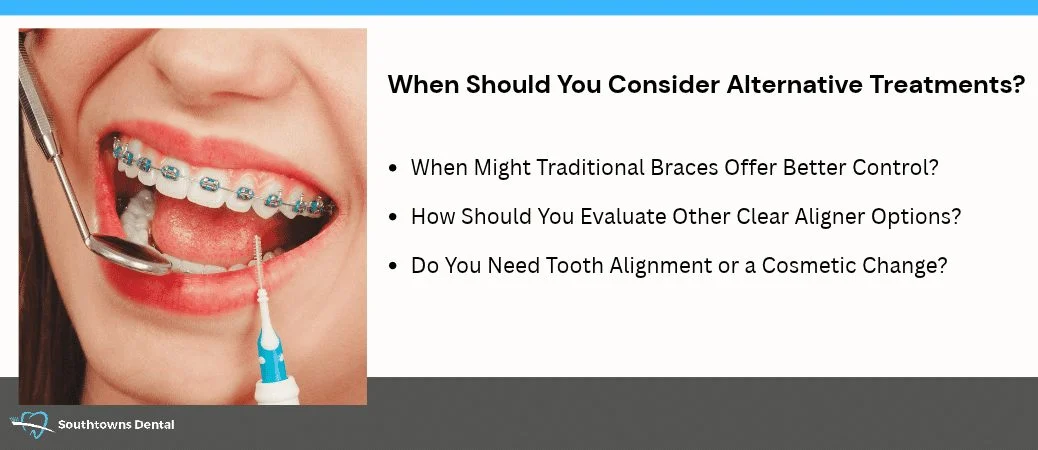
When Might Traditional Braces Offer Better Control?
Your orthodontist may favor traditional braces for difficult rotations, impacted teeth, or movements needing close root control.
Fixed appliances also reduce reliance on remembering to reinsert trays, although you still need careful cleaning and any prescribed elastic wear.
When weighing Invisalign versus traditional braces, ask how each option handles your hardest movement.
| Treatment factor | Invisalign | Traditional braces |
| Removal at home | Removable trays | Fixed brackets |
| Daily wear responsibility | Reinsert after breaks | Keep appliances intact |
| Cleaning access | Remove trays | Clean around brackets |
| Movement support | Attachments or elastics | Wires or elastics |
| After treatment | Retention required | Retention required |
How Should You Evaluate Other Clear Aligner Options?
Compare Invisalign alternatives by the clinical care included with your treatment. Ask who diagnoses your bite and who takes responsibility if movement causes a problem.
Your questions should cover in-person examinations, necessary imaging, progress monitoring, and access to urgent advice.
Confirm whether your plan allows attachments and additional aligners when needed, and ask what happens if treatment needs to change.
Do You Need Tooth Alignment or a Cosmetic Change?
You need to identify whether your concern involves tooth position, color, shape, or a combination. Teeth whitening changes color; porcelain veneers and composite bonding change visible shape or appearance.
Your cosmetic dentistry options deserve careful discussion if you are considering a smile makeover. Ask a cosmetic dentist how a smile design would affect healthy tooth structure and future maintenance.
If your concern includes excessive gum display, ask whether gummy smile treatment addresses its cause.
What Should You Bring and Ask at Your First Consultation?
Bring your dental history and written questions so you leave with a clear explanation of your eligibility. Your consultation should establish the problem, the proposed treatment, and any steps needed before starting.
Which Records, Medications, and Dental History Should You Share?
Bring an up-to-date medication list, relevant medical conditions, and details of earlier orthodontic treatment.
Include supplements and medicines for bone conditions, since your clinician needs that information when planning tooth movement.
Ask your general dentist to share recent records when appropriate. Before your consultation at Southtowns Dental, note any changes in your teeth or bite and bring your existing retainer, if you have one.
What Examination and Imaging May Be Needed?
Expect an examination of your teeth, gums, and bite before a treatment recommendation. Your records may include photographs, a digital scan or impressions, and dental X-rays selected for your needs.
Your scan shows tooth surfaces, while X-rays provide information about roots and supporting bone.
Ask why each image is needed and whether existing images are sufficient; a three-dimensional X-ray is reserved for a clinical reason.
What Should You Ask About Limitations, Timing, and Total Cost?
Ask what your proposed plan aims to achieve and which concerns are likely to remain. Treat a digital preview as a planning tool, since your teeth’s response still needs monitoring.
Get your Invisalign cost estimate in writing, with clear answers to these questions:
- What treatment is included in the quoted fee?
- Will you need attachments, elastics, or enamel reduction?
- What happens if you need additional aligners or a change of approach?
- Are your retainers and their replacement costs included?
- How will insurance benefits, payment terms, and interruptions be handled?
Ask for a treatment time range and the reasons it could change. Your estimate should account for bite correction and finishing work.
How Can You Discuss Dental Anxiety and Appointment Needs?

Tell your team about dental anxiety before the visit so they can help you prepare. Explain which parts concern you, such as impressions, instruments, or feeling unable to pause.
Ask about a stop signal, breaks, and explanations before each step.
If your anxiety is severe, discuss whether sedation dentistry for dental anxiety is appropriate for any necessary procedures, including its medical requirements and transportation arrangements.
Use Your Checklist to Start an Informed Conversation
Your checklist should help you identify likely suitability, dental issues needing attention first, and reasons to discuss another approach. You do not need to decide your own diagnosis before making an appointment.
Before your visit, mark each statement as “yes,” “no,” or “ask”:
- Your main alignment concern is clear.
- Your teeth and gums have had a recent health check.
- You have disclosed existing dental work and grinding.
- Your routine supports prescribed aligner wear.
- You are prepared for reviews and long-term retention.
- You understand the proposed limitations and written costs.
Understanding your Invisalign candidacy starts with a professional evaluation of your teeth, gums, and bite.
If you have unanswered questions, the team at Southtowns Dental can help you understand whether clear aligners are suitable, whether dental treatment is needed first, or whether another orthodontic approach may be more appropriate.
Frequently Asked Questions
Your eligibility questions need answers that account for your dental health and the movements required. These points help you prepare for a discussion about Invisalign, clear aligners, or traditional braces.
Am I too old for Invisalign?
You can qualify for Invisalign as an older adult if your teeth and supporting tissues are healthy enough for movement. Your gum health, bone support, and medical history carry more weight in the decision than your age alone.
Can teenagers qualify for Invisalign?
You can qualify as a teenager when your dental development and ability to follow the wear schedule support treatment. Your orthodontic evaluation should account for growing jaws and incoming teeth.
Plan your school-day orthodontic routine around meals, cleaning, and safe appliance storage.
Can I get Invisalign if I have crowns or missing teeth?
You may qualify with crowns or missing teeth after your clinician checks their condition and position.
A crowned natural tooth retains a root that responds to orthodontic forces, while an implant stays fixed in the bone. Your plan needs to coordinate any gap closure or future tooth replacement.
Does an overbite automatically rule out Invisalign?
You may still qualify with an overbite, including selected cases of excessive vertical overlap.
Ask your clinician to distinguish a deep bite from increased horizontal overlap, called overjet, and explain whether tooth position or jaw structure drives your problem.
Can I have Invisalign if I previously wore braces?
You may qualify for Invisalign if your teeth have shifted after earlier braces. Your clinician should assess why the change happened and develop a retention plan that addresses it after correction.
What if I cannot wear my aligners for the recommended hours?
Tell your clinician before starting if the prescribed wear time is unrealistic for you. Insufficient wear raises the risk of poor tray fit and delayed treatment. Ask whether traditional braces would suit your routine, and avoid advancing to the next tray without advice when your current one does not fit.